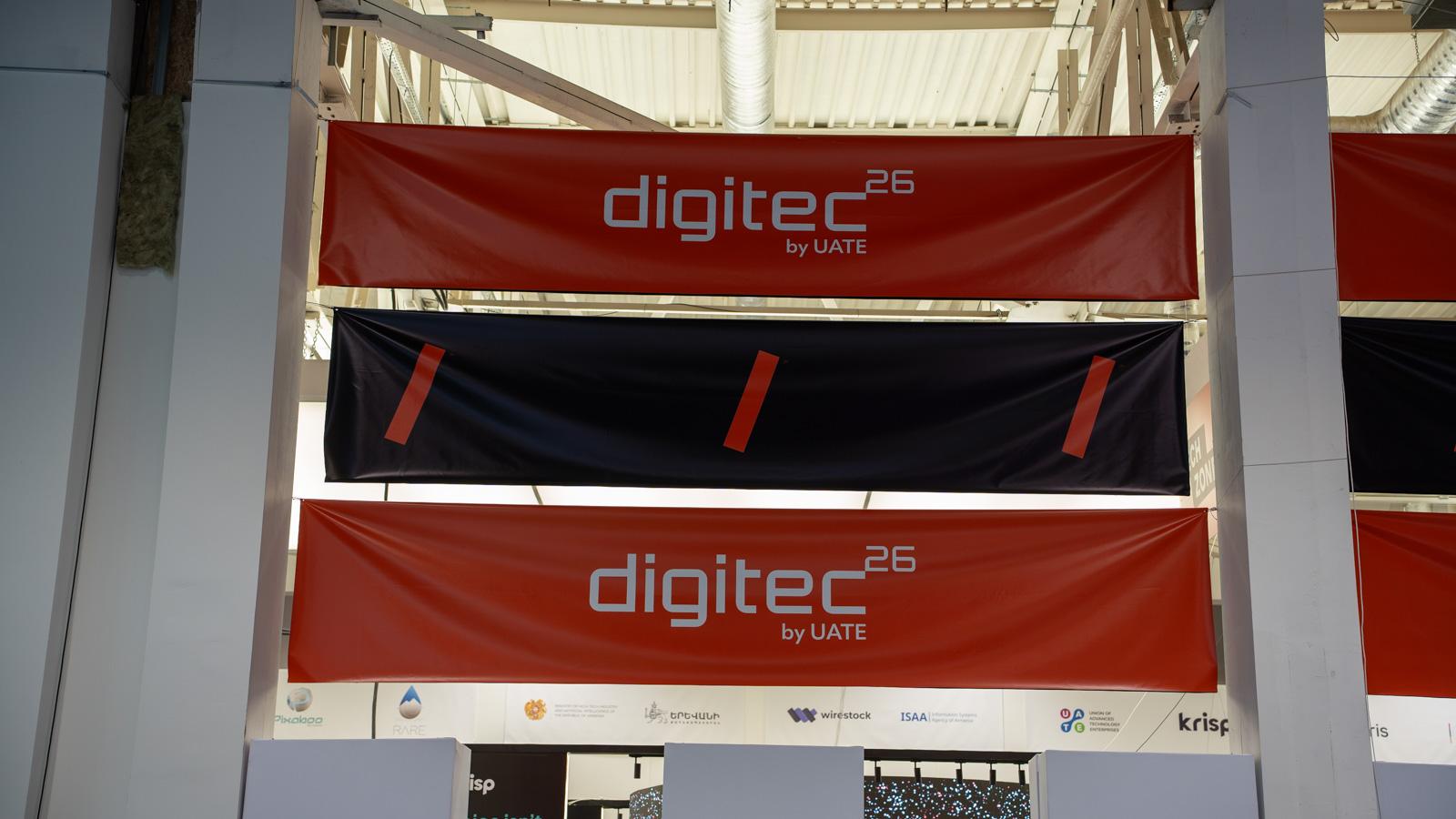
From November 20 to 22, Yerevan hosted the 21st annual technology forum and international exhibition Digitec 2026, organized by the Union of Advanced Technology Enterprises (UATE) with the support of the Ministry of High-Tech Industry and Artificial Intelligence of the Republic of Armenia. Over three days, the venue welcomed more than 30,000 visitors from over 30 countries, more than 200 companies set up their booths, and over 100 speakers took the four stages—ranging from vice presidents of NVIDIA and OpenAI to the Prime Minister of Armenia and a Nobel Peace Prize laureate. The IXBT.am editorial team breaks down the exhibition’s biggest announcements, panel discussions, and premieres.
A new course: from engineering outsourcing to computing exports
In 2026, the South Caucasus’s premier tech event shifted its perspective: while the exhibition was previously mostly a showcase for local startups and outsourced development, the forum has now gone truly international under the motto “World’s New AI Hub”. Interest in the business program proved unprecedented—tickets for the conference tracks sold out completely the day before the opening.
The organizers structured the entire program around the full artificial intelligence stack—the “One AI. Five Layers” concept:
- Energy: power grids and generation for data centers (Schneider Electric, Karpowership, Kinetics Energies).
- Chips & Compute: GPUs, FPGAs, and accelerators (NVIDIA, AMD, Microchip Technology, BlueQubit, Grovf).
- Infrastructure & Data: data centers, network architecture, and data pipelines (AWS, Dell Technologies, Firebird, Eleveight AI, Netris, Unum Cloud, Wirestock, HyperCore).
- AI Models & Training: foundation models and training frameworks (OpenAI, Toloka, FieldAI).
- Applications & Tools: end products, AI agents, and robotics (Revolut, Mozilla, Picsart, Krisp, Agile Robots, Kestrel Robotics, Tabby, Snoonu, Cognaize).
Four stages ran in parallel: the main DigiConf stage (600 seats) for strategic panels, the DigiHub engineering hall (150 seats) for deep technical sessions, the DigiTalk stage, and the Silent Talks area.
Day 1: Betting on Physical AI, limits of large models, and the gigawatt challenge
The conference’s first day was opened by Minister of High-Tech Industry and AI Davit Tadevosyan, UATE President Armen Kocharyan, Krisp Co-Founder Artavazd Minasyan, Firebird AI President Aleksandr Yesayan, and NVIDIA Vice President of Omniverse and Simulation Technology Rev Lebaredian. The central takeaway of the plenary session set the tone for the entire event: Armenia must transition away from being solely a provider of engineering services and evolve into an exporter of computing capacity and R&D products.
In his keynote address “The Future of Armenia in the Era of AI,” Rev Lebaredian explained why Physical AI and digital twins will become the next trillion-dollar market after large language models (LLMs), and how Armenia’s local infrastructure can integrate into the global production chain.
On the business track, pragmatism replaced hype:
- Enterprise production: Adrian McDonald, President of Dell Technologies EMEA, examined how large enterprises are moving AI initiatives out of endless pilot stages and into full-scale production.
- Model economics: In his talk “Why Bigger Keeps Betraying You,” Cognaize Founder Vahe Andonians pointed out that the race toward massive models is losing on enterprise P&L sheets—computational efficiency is becoming the overriding metric.
- Voice and data scarcity: Artavazd Minasyan (Krisp) demonstrated the evolution of voice AI developed in Yerevan, while at the end of the day SuperAnnotate Founder Vahan Petrosyan and Wirestock CEO Mikayel Khachatryan addressed where frontier research labs will source labeled data once the public internet is exhausted in a candid panel titled “Who Feeds the Models.”
- The power ceiling: In the session “Powering the AI Hub,” representatives from Schneider Electric, Karpowership, HyperCore, and the Agora Energiewende think tank highlighted the primary barrier to data center growth—accessible gigawatts of power capacity and cross-border energy bridges.
Day 2: Pashinyan’s dialogue with NVIDIA, tens of thousands of GPUs, and robots
How Armenia plans to export compute abroad
The centerpiece of the second day was a one-hour open dialogue between Prime Minister Nikol Pashinyan and NVIDIA Vice President Rev Lebaredian titled “AI Opportunities for Armenia: From Vision to Action.”
The Prime Minister linked data center development with the “Crossroads of Peace” project and the TRIPP infrastructure initiative (slated to launch in the coming days): Armenia aims to export computing and AI services to regional and international markets via fiber-optic corridors. To supply data centers with power, the national grid, already synchronized with Iran and Georgia, will be interconnected with the power grids of Turkey and Azerbaijan, with industrial energy storage systems becoming a top priority to balance solar generation. Pashinyan stressed separately that AI adoption across the public sector aims to raise civil servants’ productivity rather than trigger layoffs, while tax revenues from AI factories will directly fund healthcare and infrastructure.
Computing infrastructure by the numbers: Firebird, Eleveight, and universities
Specific figures regarding the computational capacity being built across the country were revealed on the sidelines of the forum:
- Firebird AI (Hrazdan): Phase one of the NVIDIA DSX-powered AI factory went live in August 2026 (6,144 processors, approximately 18 MW). By late 2027, the site will expand to over 70,000 NVIDIA Blackwell and Rubin GPUs (300 MW), eventually scaling up to 110,000 GPUs in its third phase. Firebird’s $10 billion partnership with Kazakhstan to develop AI infrastructure was also highlighted.
- Eleveight AI (Gagarin, Gegharkunik): The data center powered by NVIDIA Blackwell B300 accelerators (launched in June 2026) is expanding from 1.5 MW to 5 MW by the end of the year and to 40 MW in 2027, with 20% of its computing resources allocated free of charge to Armenian universities and research centers.
- Public resources and education: The government is purchasing 181 GPUs from Firebird for startups and researchers (access guidelines are open for public consultation until December 2), while YSU, Polytechnic, and the American University of Armenia are kicking off a 7-year Physical AI program backed by a $14 million budget, utilizing YSU’s supercomputer (64 NVIDIA H100 modules) and Firebird’s infrastructure.
Hardware, models, and robotics
The engineering and research program of the second day spanned the entire development lifecycle:
- Oculus Co-Founder Jack McCauley explored the role of AI in physical hardware design and visual effects two decades after the spatial computing industry was launched.
- Engineers from AMD Armenia, Synopsys, and Microchip compared MCU, GPU, and FPGA architectures for Edge Physical AI.
- Anton Repushko, Head of AI Research at Revolut (leading the PRAGMA banking model), Mikhail Filippov, Lead of Developer Productivity at JetBrains (Mellum models), and Olga Megorskaya, CEO of Toloka, discussed post-training open models within corporate environments.
- The evening track concluded with robotics leaders: FieldAI CEO Ali Agha (on the necessity of embedding laws of physics into robots rather than just terabytes of video), Kestrel Robotics Founder Naira Hovakimyan (on L1 adaptive control theory for autonomous drones and spacecraft), and Mozilla CTO Raffi Krikorian with a presentation on open-source AI at the browser and core infrastructure levels.
Day 3: OpenAI and NVIDIA engineering tracks, fintech, and cybersecurity
The final day shifted its focus toward applied engineering, governance, and regional collaboration. Presentations were delivered by representatives from OpenAI (Head of Compute Infrastructure Suren Harutyunyan and Lead for Policy and Partnerships in MENA and Central Asia Rod Soleymani), engineers from NVIDIA (unveiling the Nemotron open-model family), AWS Solutions Architect Matias Undurraga analyzing industrial generative AI deployments, and Firebird CTO Harut Martirosyan presenting a hands-on guide to Firebird Cloud.
- Fintech and proprietary AI: Deputy Governor of the Central Bank of Armenia Armen Nurbekyan moderated a debate among Revolut, Tabby, Comfi.ai, and Anchorage Digital titled “Proprietary Models vs. Off-the-Shelf APIs.”
- Cybersecurity of autonomous agents: Head of the Information Systems Agency Nerses Yeritsyan, CBA Deputy Governor Hovhannes Khachatryan, President of France’s Campus Cyber Geoffroy Célestin-Urbain, and Synergy CEO Ashot Hovanesyan discussed critical infrastructure defense in the era of AI agents (Armenia’s cybersecurity regulations already encompass 280 categories of economic activity). A memorandum establishing the Armenian Cyber Campus was also signed at the event.
- Regional alliance (“The New Silk Road”): Armenia’s Minister of High-Tech Industry and AI Davit Tadevosyan, Kazakhstan’s Vice Minister of AI and Digital Development Bakhtiyar Mukhametkaliyev (accompanied by Deputy Prime Minister Zhaslan Madiyev as part of the delegation), Greece’s Deputy Minister of Foreign Affairs Harry Theoharis, and Bulgaria’s Deputy Minister of Innovation Mira Yosifova addressed cooperation in AI infrastructure to prevent technological lock-in with global monopolies. Concurrently, leaders of UATE, Astana Hub (Kazakhstan), GITA (Georgia), and IT Park Uzbekistan aligned their roadmaps toward building a shared market for capital and talent.
- A humanistic finale: The conference was brought to a close by Nobel Peace Prize laureate Kailash Satyarthi, who dedicated his speech to ethics, human rights advocacy, and safeguarding fundamental human values in AI governance.
Digitec 2026 exhibition: bioprinter, robotics, telecom, and banking
Inside the exhibition halls of Meridian, where admission remained free with prior registration, more than 200 booths were set up—spanning global vendors to school robotics clubs.
One of the key technical debuts in the expo hall was Ontogenesis, a compact desktop bioprinter engineered entirely in Armenia by bioengineering company Foldink in partnership with 3D printer manufacturer TI-3D. The device can print with four or more biomaterials simultaneously, constructing living tissue structures. Alongside biotech exhibits, attendees saw robotic dogs, autonomous drones, and industrial robotic arms—including those from a partnership with Germany’s Agile Robots, whose initial units are already arriving at Armenian universities under the Physical AI program.
Major telecom operators and commercial banks showcased digital ecosystems and practical AI deployments. Telecom operator Viva unveiled its enterprise platform Viva IoT Hub for real-time smart sensor monitoring and control, alongside a cloud-based virtual PBX (VPBX) featuring fixed-mobile convergence (FMC). In the banking sector, IDBank introduced currency trading platform Rate.Trading (integrated into the Idram&IDBank app and the rate.am service), which enables businesses and individuals to submit custom online currency exchange orders at their chosen exchange rates. Ardshinbank turned its booth into an interactive co-creation lab, gathering real-world AI use cases directly from visitors, while also welcoming an AWS delegation led by Matias Undurraga at its Yerevan IT hub on Arshakunyats Avenue. Products, R&D divisions, and open roles were also showcased by Krisp, Picsart, SuperAnnotate, Synopsys, AMD, Microchip, Dell, Schneider Electric, Netris, and Synergy.
A significant area of the exhibition featured ecosystem platforms, startups, and youth competitions. In Startup Alley, 84 early-stage teams displayed prototypes, after which finalists pitched to international VC funds and angel investors on the Startup Arena supported by the BANA Angels network. At the same time, the venue hosted the official launch of the country’s tech ecosystem portal, Armenia Ecosystem Platform, built in collaboration with analytics platform Dealroom.
Hands-on robotics was represented across two initiatives. The 18th national autonomous robotics championship, ArmRobotics, saw top youth teams from a record 180 applicants qualify for the finals, with their autonomous machines tackling challenges on an obstacle course themed around “Smart Robots at the AI Factory.” Alongside them, students from the free school engineering laboratories Armath under UATE auspices (now reaching over 17,000 students nationwide) showcased their work—students brought their own custom CNC machines, 3D printers, and robotics designs to Yerevan.
Behind the scenes: a closed business breakfast and a visit from Iran’s delegation
Beyond the public agenda, Digitec 2026 served as a venue for high-level closed talks. At the initiative of Enterprise Armenia and UATE, Prime Minister Nikol Pashinyan held a working breakfast with executives of Armenian and international tech firms, discussing tax incentives, talent development, and the removal of regulatory bottlenecks. The exhibition was also visited by an official delegation from the Ministry of Information and Communications Technology of Iran—the respective ministers of Armenia and Iran toured exhibitor booths and discussed joint projects in telecommunications and high technology.
The central takeaway of the 21st Digitec is clear: driven by the deployment of real megawatt-scale and GPU initiatives on the order of Firebird and Eleveight, alongside the presence of top executives from NVIDIA, OpenAI, Dell, and AWS, the Yerevan forum has outgrown its identity as a regional trade show and reinforced Armenia’s bid to become a vital compute and energy hub bridging Europe, Central Asia, and the Middle East.